


Classifieds Conference "Classifieds: RECIPES FOR SUCCESS" will take place 27-30 April 2011 at Nice, France.
The conference programme will cover the four main "recipes" for success - money, content, technology and content.
ICMA members and delegates benefit from the sharing of invaluable information with the worldwide community of classified media professionals. Read more about the Conference.
|
|
|---|
Wednesday, January 12, 2011

Tuesday, January 11, 2011
Confused by Simulink
The most common modelling tool in the automotive domain is Simulink. It started as a Matlab-based tool to graphically model and simulate differential equations needed in control design. Now it has expanded way beyond that to enable generation of production code for embedded controllers.
For someone like me, with a background in software and systems engineering and only the mandatory control engineering course, Simulink is confusing. Not the model elements as such, since it basically is an executable time-discrete data flow model. But the terminology used in the Simulink community is really confusing since they are using terms very common in software development, but with different meanings. I am not even sure the explanations below are valid...
Some examples:
For someone like me, with a background in software and systems engineering and only the mandatory control engineering course, Simulink is confusing. Not the model elements as such, since it basically is an executable time-discrete data flow model. But the terminology used in the Simulink community is really confusing since they are using terms very common in software development, but with different meanings. I am not even sure the explanations below are valid...
Some examples:
- A layer in Simulink is not what what one usually calls a layer in software. What is called a layer in Simulink I would personally call a view since it adresss a specific concern, see some defintion of the J-MAAB layers here. But I have also seen a layer as something found at a certain level in a functional hierarchy (boxes in boxes...). Maybe these two even are the same in the Simulink world?
A software layer would rather be called a subsystem in Simulink, but that is a generous interpretation from my side. (See Pattern-Oriented Software Architecture by Buschmann et al. for a definiton of software layer). - There are classes and objects in Simulink. Data objects are used to "specify values, data types, tunability, value ranges, and other key attributes of block outputs and parameters", where blocks are the basic entities that one build the simulink model from.
The Simulink software uses objects called data classes to define the properties of specific types of data objects." So in a sense the class is a template for the objects. On the other hand the data object does not specify a behaviour or input-output relationship. But classes seem also to be a special type of objects in thelast quote above. Ouch!
Contrast this to common OO design where the class is the template for the object, which is the main item encapsulating both a behaviour and associated data. A block in Simulink most closely resembles a function in a procedural language such as C or Pascal.
Monday, January 10, 2011
The Plural Of Prius is Priora
Toyota is asking "What is the plural of Prius?".
Since Prius is a Latin word, if it is pluralized in Latin, they should probably be called "Prius" or "Priora". Apparently "Prii" is not correct.
There is a long explanation here (not mine).
Saturday, January 8, 2011
The Ford Focus Electric "Butterfly Effect"
Ford's big unveiling at the CES in Las Vegas was its new Focus Electric, and associated apps and charging stations.

One of the items that caught my attention was the cutesy butterfly graphics that, like the green leaves on the Ford hybrid instrument clusters, give positive feedback about your driving style. Ford said that the butterflies were inspired by "the butterfly effect".
The Butterfly Effect is an illustration of instability in nonlinear systems, (also known as "Chaos theory"). Which I happened to take a class on in college. Basically, if you have a nonlinear system, and you start out at two very similar but not identical starting points, you may wind up in a very different state. That is, small perturbations may case large changes in the final outcome. The old example was the butterfly that flapped its wings, and caused the weather to shift on another continent.
What this has to do with driving a Focus EV I am not sure. Do they mean to say that driving a Focus EV will save enough gasoline to cause the Saudis to go broke? Seems doubtful. Perhaps a Ford P.R. guy can email me and explain it. In the meantime, I propose that there should be a "Punisher Mode" for these displays.
How this would work is when you drive like a bad-ass, you get little skulls. Hard acceleration, high lateral g's, hard braking, etc.

Friday, January 7, 2011
Concept Car: Hyundai HCD-12 Curb

Named HCD-12 Curb, the concept was designed at Hyundai’s Californian design centre. Although the crossover looks very similar in size to the Nissan Juke, the Curb is in fact longer than the Juke and may preview the next Santa Fe mid-sized SUV.
The concept features Hyundai’s next-generation ‘fluidic sculpture’ exterior design language. A steeply raked front windscreen, narrow glasshouse and C-pillars that slant away all give a coupe-like silhouette from the side.

Inside, the ultramodern interior with front bucket seats is confronted by a touch-screen infotainment system and a rotary knob sit on the centre console.
Ferrari working on mind-reading technology

The mind-reading tech was drawn out in many European and worldwide patent applications. The papers reveal how Ferrari imagines a wide-range of sensors provide data on the driver, to allow set-up adjust appropriately.
Ferrari’s documentation states: “Drivers tend to miscalculate — in particular, overestimate — their driving skill and, more importantly, their psychophysical condition, with the result that driver-selected dynamic vehicle performance simply reflects the driver’s wish, as opposed to the driver’s actual psychophysical condition and proficiency.”

Ferrari says: “The dynamic performance may be modified to enhance driving safety in the case of a tired or unresponsive driver, and also to enhance driving pleasure and/or performance in the case of an alert, responsive driver.”
Via Autocar
Volvo V60 New Car Advanced Stability Control Design 2011

Elegant estate coupe car design technology presented on this official image gallery new 2011 Volvo V60 in metallic paint color exterior design. You simply have to drive this modern city sedan car to appreciate how we have driven chassis development to its pinnacle. Sophisticated luxury car combine with comfort interior design. Volvo’s new sports car wagon is available with an option of two chassis. When cornering, the car’s inner driven wheel is broken, causing more power to be transmitted to the outer driven wheel. The sporty interior of the new Volvo V60 is also the most advanced high-tech environment ever available to a Volvo driver.
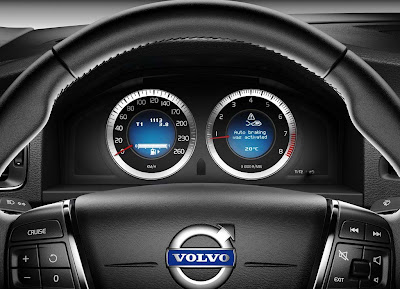
2011 Volvo V60 come with new innovation features Advanced Stability Control technology. Detail specification reviews, tuning car performance are available on first test drive vehicles report. The car engine’s power is delivered to the wheels using Volvo’s second-generation six-speed automatic Geartronic transmission. The 150 horsepower engine presents 240 Nm of torque. Both turbo diesels are obtainable with a 6 speed automatic car transmission otherwise six-speed manual gearbox. The initial annual target for the new Volvo V60 is 50,000 cars. The new Volvo V60 is built at the Volvo Cars production plant in Torslanda, Sweden. Check the new car 2011 Volvo price list at the market by visit the official Volvo car maker company website.


Subscribe to:
Posts (Atom)


