Sunday, August 1, 2010

Porsche produces 25,000th Panamera sedan

Porsche has announced that the 25,000th Panamera has rolled off the assembly line in Leipzig, Germany. The milestone car, a ruby red Panamera, is destined for a customer in the United States. Under the hood is a 3.6 litre V6 engine with 296bhp (300PS) and 400Nm (295lb-ft) of torque.

According to Bernhard Maier, Executive Vice President Sales and Marketing, "The benchmark performance of our Panamera V6 models wins over our customers worldwide. Even in the USA, a country with a preference for V8 engines, they impress with their efficiency and sportiness. The 4-door combines these aspects with the comfort and exclusivity of the luxury class."

The Panamera launched in September 2009 and quickly became one the best selling Porsche models of all time. In recent months, the sedan has outsold the Cayenne in the U.S. It was only back in December when Porsche produced its 10,000th Panamera.

Supercar Imola - Ferrari Sports Car Concept by John Mark Vicente


 Supercar Imola Ferrari Sports Cars Concept by John Mark Vicente
The another design by John Mark Vicente: the Ferrari Imola, after the sublime Bugatti Renaissance concept. According to the author, his Ferrari concept car is inspired by the Ferrari F70 created by Randy Rodriguez and the Dino Competizione by Sacha Selipanov.
This time, an Italian one that could give plenty of ideas to the designers at Ferrari. Imola is a spider without windscreen and has a future hybrid Ferrari V6 engine. The designer used triangular and trapezoidal shapes to create the head and tail lights and the grille.

The enormous rims and semi-slick tires underline the aggressiveness of the vehicle. This supercar is ready to take on the road monsters like Ariel Atom, Caparo T1, KTM X-Bow and especially the Lotus Elise.


 Supercar Imola Ferrari Sports Car Concept by John Mark Vicente

Supercar Imola - Ferrari Sports Car Concept by John Mark Vicente


 Supercar Imola Ferrari Sports Cars Concept by John Mark Vicente
The another design by John Mark Vicente: the Ferrari Imola, after the sublime Bugatti Renaissance concept. According to the author, his Ferrari concept car is inspired by the Ferrari F70 created by Randy Rodriguez and the Dino Competizione by Sacha Selipanov.
This time, an Italian one that could give plenty of ideas to the designers at Ferrari. Imola is a spider without windscreen and has a future hybrid Ferrari V6 engine. The designer used triangular and trapezoidal shapes to create the head and tail lights and the grille.

The enormous rims and semi-slick tires underline the aggressiveness of the vehicle. This supercar is ready to take on the road monsters like Ariel Atom, Caparo T1, KTM X-Bow and especially the Lotus Elise.


 Supercar Imola Ferrari Sports Car Concept by John Mark Vicente

Mustang-Saleen-S7-Twin-Turbo-Design-Sport-Car

Mustang-Saleen-S7-Twin-Turbo-Design-Sport-CarMustang-Saleen-S7-Twin-Turbo-Design-Sport-Car

Saleen knows all about power. As in S281 Mustangs, N2O Focuses and the S7, America’s first (and still the only) mid-engine exotic supercar. When it went on sale in 2002, the S7 was the only street-legal car in the U.S. with more than 500 horsepower and 500 lb-ft of torque. The media and S7 owners have raved about the car since it first smoked the rear tires in anger. And it has been recognized by numerous automotive magazines as the fastest production car in the world. But during the past three years the automobile marketplace has witnessed an explosion of performance with models from manufacturers including Ferrari, Lamborghini, Mercedes-Benz, Porsche and Chevrolet touting power numbers above the once magic 500 level.
Designed by Saleen engineers, the S7's engine and drivetrain incorporate the latest in modern racing technology. The new all-aluminum V8 engine casting was engineered and tooled by Saleen to displace seven liters. Redline is 6500 rpm. Space age materials and engineering are used throughout, including stainless steel valves, titanium retainers, beryllium exhaust valve seats, an aluminum throttle body, Saleen designed aluminum CNC-machined cylinder heads and stainless steel exhaust system. An exclusive Saleen-designed Front Engine Accessory Drive (FEAD) system results in an extremely compact engine, allowing for better packaging and overall weight distribution. The V8 incorporates a unique Saleen-designed side-mounted water pump, a belt-driven camshaft drive and a Saleen-engineered dry sump oil delivery system. The engine's mid-chassis placement optimizes weight distribution and center of gravity, making room for an unusually tall engine that allows for a very efficient induction system. Air enters a roof intake, passes through a 90-mm mass air meter and feeds into a carbon fiber plenum. From the plenum the air is routed to the twin ball bearing turbos, is pressurized to 5.5 psi max and then passes through an oval-bore throttle body into an aluminum intake manifold with eight individual runners.

Mustang-Saleen-S7-Twin-Turbo-Design-Sport-Car

Mustang-Saleen-S7-Twin-Turbo-Design-Sport-CarMustang-Saleen-S7-Twin-Turbo-Design-Sport-Car

Saleen knows all about power. As in S281 Mustangs, N2O Focuses and the S7, America’s first (and still the only) mid-engine exotic supercar. When it went on sale in 2002, the S7 was the only street-legal car in the U.S. with more than 500 horsepower and 500 lb-ft of torque. The media and S7 owners have raved about the car since it first smoked the rear tires in anger. And it has been recognized by numerous automotive magazines as the fastest production car in the world. But during the past three years the automobile marketplace has witnessed an explosion of performance with models from manufacturers including Ferrari, Lamborghini, Mercedes-Benz, Porsche and Chevrolet touting power numbers above the once magic 500 level.
Designed by Saleen engineers, the S7's engine and drivetrain incorporate the latest in modern racing technology. The new all-aluminum V8 engine casting was engineered and tooled by Saleen to displace seven liters. Redline is 6500 rpm. Space age materials and engineering are used throughout, including stainless steel valves, titanium retainers, beryllium exhaust valve seats, an aluminum throttle body, Saleen designed aluminum CNC-machined cylinder heads and stainless steel exhaust system. An exclusive Saleen-designed Front Engine Accessory Drive (FEAD) system results in an extremely compact engine, allowing for better packaging and overall weight distribution. The V8 incorporates a unique Saleen-designed side-mounted water pump, a belt-driven camshaft drive and a Saleen-engineered dry sump oil delivery system. The engine's mid-chassis placement optimizes weight distribution and center of gravity, making room for an unusually tall engine that allows for a very efficient induction system. Air enters a roof intake, passes through a 90-mm mass air meter and feeds into a carbon fiber plenum. From the plenum the air is routed to the twin ball bearing turbos, is pressurized to 5.5 psi max and then passes through an oval-bore throttle body into an aluminum intake manifold with eight individual runners.

A10 Ascari sports car V-8 engine

 A10 Ascari sports car V-8 engine
A10 Ascari sports car V-8 engine

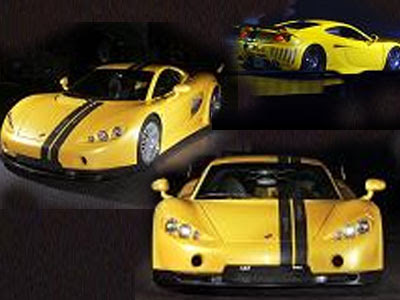
The Ascari A10 lightweight carbon fiber body of less than 3,000 pounds is designed more for the racetrack than the road. There were only a few models of this fast car built, somewhere between 10 and 50, and although expensive, it promises incredible speed and power.The Ascari A10 sports car, developed by British manufacturers and similar to the Spanish GT version, is rated in the top ten supercars for 2006.
The power of the Ascari A10 comes from the modified BMW 5.0 liter V-8 engine, with the standard six-speed sequential transaxle, where the gearshifts operate as paddles, similar to other race cars. Additions and modifications to the engine, however, include cams with advanced timing, new rods, and pistons, as well as a dry sump lubrication system. It has the same steel sub-frame for the power train and rear suspension as the KZ1 sports car, but the height of the coil spring units can be adjusted hydraulically on front and rear. This is a unique feature, not found on most other supercars, where adjustments can only be made manually. Handling should be easier than before, with front and rear anti-roll bars installed, which are also adjustable. The builders of the A10, not to be outdone by their competitors and to ensure adequate braking at such high speeds, have installed ventilated ceramic disc brakes, with 6-pot calipers on the front and 4-pot calipers on the rear.
Ascari A10 rear view image
The exterior design of this luxury race car is more dramatic than its predecessor the KZ1, with wider headlamps, a different grille, and higher wheel arches to accommodate larger rear tires. In addition, it features a splitter in the front, fixed rear wing, and five detachable body panels for added race trace utility. Even with standard features such as a battery isolator, rollover cage, electric windows, and air conditioning, it still weighs 55 pounds less than the KZ1.
Klaas Zwart, the owner of Ascari, may well have designed the fastest exotic car in the UK, outperforming the Ferrari Enzo as is claimed. The A10 is certainly a rare and distinctive car, one that is much desired to own.

A10 Ascari sports car V-8 engine

 A10 Ascari sports car V-8 engine
A10 Ascari sports car V-8 engine

The Ascari A10 lightweight carbon fiber body of less than 3,000 pounds is designed more for the racetrack than the road. There were only a few models of this fast car built, somewhere between 10 and 50, and although expensive, it promises incredible speed and power.The Ascari A10 sports car, developed by British manufacturers and similar to the Spanish GT version, is rated in the top ten supercars for 2006.
The power of the Ascari A10 comes from the modified BMW 5.0 liter V-8 engine, with the standard six-speed sequential transaxle, where the gearshifts operate as paddles, similar to other race cars. Additions and modifications to the engine, however, include cams with advanced timing, new rods, and pistons, as well as a dry sump lubrication system. It has the same steel sub-frame for the power train and rear suspension as the KZ1 sports car, but the height of the coil spring units can be adjusted hydraulically on front and rear. This is a unique feature, not found on most other supercars, where adjustments can only be made manually. Handling should be easier than before, with front and rear anti-roll bars installed, which are also adjustable. The builders of the A10, not to be outdone by their competitors and to ensure adequate braking at such high speeds, have installed ventilated ceramic disc brakes, with 6-pot calipers on the front and 4-pot calipers on the rear.
Ascari A10 rear view image
The exterior design of this luxury race car is more dramatic than its predecessor the KZ1, with wider headlamps, a different grille, and higher wheel arches to accommodate larger rear tires. In addition, it features a splitter in the front, fixed rear wing, and five detachable body panels for added race trace utility. Even with standard features such as a battery isolator, rollover cage, electric windows, and air conditioning, it still weighs 55 pounds less than the KZ1.
Klaas Zwart, the owner of Ascari, may well have designed the fastest exotic car in the UK, outperforming the Ferrari Enzo as is claimed. The A10 is certainly a rare and distinctive car, one that is much desired to own.